
Article: Toxic Ingredients in Skincare: What to Avoid and Why It Matters.
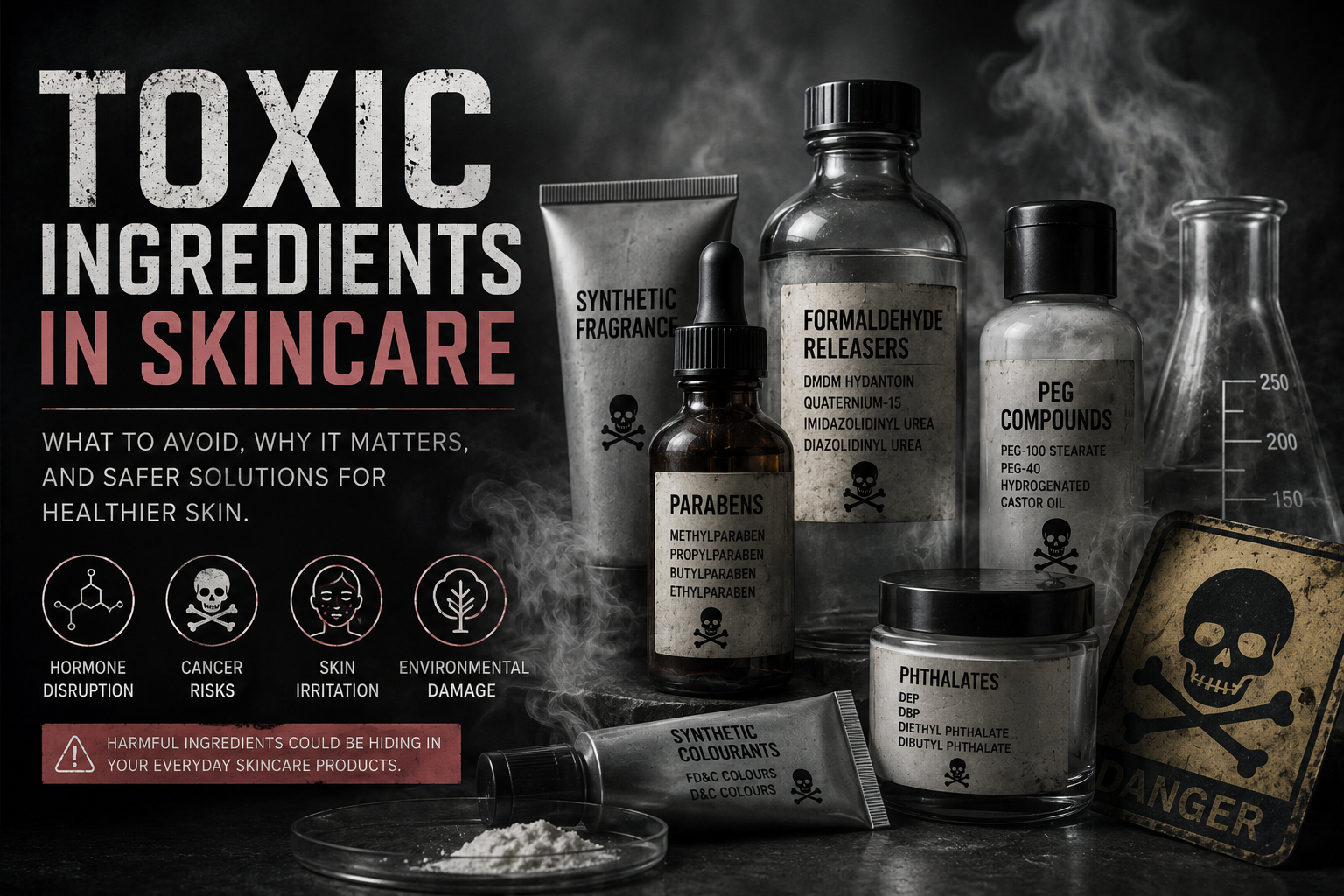
Toxic Ingredients in Skincare: What to Avoid and Why It Matters.
Toxic Ingredients in Skincare: What’s Really Inside Many Beauty Products?
The modern skincare industry is worth billions.
Every year, thousands of new creams, lotions, serums, moisturisers, body butters, cleansers, and beauty products enter the market promising smoother, healthier-looking skin.
Yet most consumers spend more time reading food labels than skincare labels.
The reality is that many conventional skincare products contain ingredients that most people cannot pronounce, do not understand, and have never researched.
This does not mean every synthetic ingredient is dangerous.
It does mean consumers should understand what they are putting on their skin every single day.
Your skin is your body's largest organ.
What you apply to it matters.
Why Ingredient Awareness Matters
Many skincare products are built around low-cost manufacturing.
Water often makes up 60–90% of the formula.
To keep that water stable for months or years, manufacturers typically add:
- Preservatives
- Stabilisers
- Emulsifiers
- Solvents
- Synthetic fragrances
- Colourants
- Texture modifiers
Most of these ingredients exist to support the product itself rather than support your skin.
While regulatory agencies monitor ingredient safety, some ingredients remain controversial due to ongoing scientific debate, long-term exposure concerns, contamination risks, or irritation potential.
Let's look at some of the most discussed ingredients in modern skincare.
Parabens
Parabens are preservatives used to prevent bacteria, mould, and yeast growth.
Common examples include:
- Methylparaben
- Propylparaben
- Butylparaben
- Ethylparaben
Why Are They Used?
Without preservatives, water-based products can quickly become contaminated.
Parabens are inexpensive, effective, and have been used for decades.
Why Are They Controversial?
Some studies have shown that parabens can mimic estrogen activity in laboratory settings.
Because hormones influence many biological processes, researchers have investigated whether long-term exposure could potentially contribute to health concerns.
Scientific organisations continue to debate the significance of real-world exposure levels.
How Common Are They?
Historically, extremely common.
Many brands have now removed parabens due to consumer demand, though they still exist in some products worldwide.
Formaldehyde-Releasing Preservatives
Formaldehyde is classified as a known human carcinogen when exposure levels are sufficiently high.
Most skincare products do not contain formaldehyde directly.
Instead, some contain preservatives that slowly release small amounts over time.
Examples include:
- DMDM Hydantoin
- Quaternium-15
- Imidazolidinyl Urea
- Diazolidinyl Urea
Why Are They Used?
They help prevent microbial contamination.
Potential Concerns
These preservatives have been associated with:
- Skin irritation
- Allergic reactions
- Sensitivity issues
Many consumers choose to avoid them entirely.
Synthetic Fragrance
"Fragrance" may look like a single ingredient.
In reality, it can represent dozens or even hundreds of individual compounds.
Why Is It Used?
To create a pleasant scent.
Why Is It Controversial?
Companies are often not required to disclose every component within a fragrance blend.
Some fragrance ingredients may trigger:
- Skin irritation
- Allergic reactions
- Sensitivity
- Redness
This is particularly important for individuals with sensitive skin.
How Common Is It?
Extremely common.
It appears in many:
- Lotions
- Moisturisers
- Body washes
- Creams
- Hair products
Phthalates
Phthalates are often used in fragrance systems.
They help scents last longer.
Why Are They Controversial?
Some phthalates have been studied for potential endocrine-disrupting effects.
Regulations vary globally, and many cosmetic manufacturers have removed certain phthalates from formulations.
How Common Are They?
Less common than in previous decades, but still present in some products.
PEG Compounds
Polyethylene glycols (PEGs) are used as:
- Emulsifiers
- Solvents
- Texture enhancers
Why Are They Discussed?
The primary concern is not always the PEG itself.
The concern can be contamination during manufacturing with compounds such as:
- Ethylene oxide
- 1,4-dioxane
Both substances are heavily regulated due to safety concerns.
Quality manufacturing significantly reduces risk, but many consumers prefer to avoid PEG-based ingredients altogether.
Synthetic Colourants
Artificial colours are commonly added to make products appear luxurious or attractive.
What Do They Do For Skin?
Usually nothing.
Their purpose is visual.
Potential Concerns
Some individuals experience:
- Irritation
- Sensitivity
- Allergic reactions
Especially with repeated exposure.
Triclosan
Triclosan was once widely used in antibacterial products.
Why Did It Become Controversial?
Research raised concerns regarding:
- Hormonal disruption
- Environmental impact
- Antibiotic resistance
Many manufacturers have now removed it.
The Bigger Question
Even when an ingredient is considered safe within regulatory limits, consumers increasingly ask a different question:
Do I actually need it?
If a formula contains:
- Large amounts of water
- Multiple preservatives
- Stabilisers
- Emulsifiers
- Synthetic texture modifiers
How much of the bottle is truly supporting the skin?
This question has driven growing interest in simpler formulations.
A Different Approach: Concentrated Botanical Lipids
Rather than building products around water, some skincare brands are moving toward concentrated lipid systems.
Lipids are naturally occurring fats that help support the skin's surface barrier.
Healthy-looking skin relies heavily on these protective lipids.
When skin lacks sufficient lipid support, it may appear:
- Dry
- Tight
- Rough
- Dull
- Less comfortable
This is where concentrated botanical oils can play a role.
The Rebel Palm Philosophy
At Rebel Palm, the focus is not on adding more water to the skin.
The focus is on supporting the skin's natural lipid environment.
Rebel Palm products are built around:
- Water-free formulations
- Concentrated botanical lipids
- No fillers
- No unnecessary dilution
- Every drop active
Instead of creating formulas that require extensive preservation systems, Rebel Palm uses carefully selected botanical oils designed to provide skin-conditioning benefits directly.
Essence Light
For morning use, Essence Light delivers lightweight botanical lipids that absorb cleanly while helping skin feel soft, smooth, and comfortable throughout the day.
Ideal for:
- Dry-looking skin
- Dull-looking skin
- Daily moisture support
Satis
Satis is designed for post-shower application.
Warm skin immediately after bathing is an ideal time to apply lipids that help reduce the feeling of dryness and leave skin feeling silky and conditioned.
Velora
Velora is the evening recovery oil.
Night-time is often when people prefer richer nourishment and comfort.
Velora helps create a luxurious overnight skin experience built around concentrated botanical oils.
Lumen Elixir
Lumen Elixir focuses on facial skincare.
Using carefully selected botanical lipids, it helps support a smoother, healthier-looking complexion while delivering the signature Rebel Palm satin finish.
Choosing Smarter Skincare
Fear-based marketing is not helpful.
Not every synthetic ingredient is dangerous.
Not every natural ingredient is automatically superior.
The real goal is understanding what you are buying.
Ask questions:
- How much of this product is water?
- Why is each ingredient included?
- Does this ingredient benefit my skin or the product itself?
- Is the formula built around performance or shelf life?
- Am I paying for active ingredients or fillers?
The more informed consumers become, the better decisions they can make.
And sometimes the most powerful skincare solution is not adding more ingredients.
It is removing the unnecessary ones.
Conclusion
Modern skincare often relies on complex formulas containing preservatives, stabilisers, synthetic fragrances, colourants, and numerous supporting ingredients.
Many of these ingredients are approved for cosmetic use, yet some remain controversial due to irritation concerns, contamination risks, or ongoing scientific debate.
As a result, many consumers are moving toward simpler, more concentrated approaches.
Rebel Palm was created around that principle.
Water-free botanical lipid formulations.
No unnecessary dilution.
No fillers.
Every drop active.
A skincare philosophy built around what the skin needs rather than what the formula needs.

Written by Andrew Karczewski
Visit author's website