
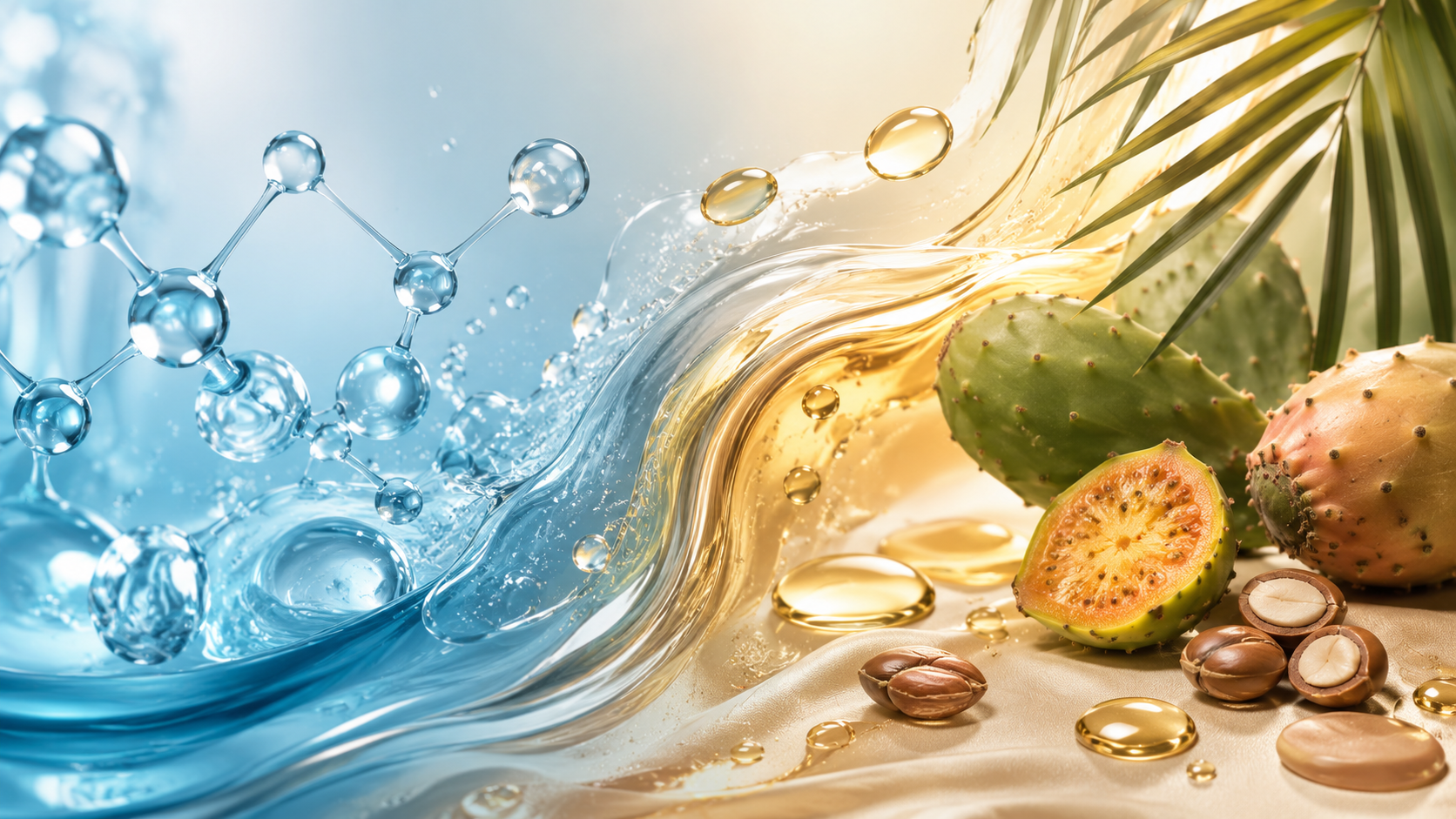
Peptides vs Botanical Lipids: Which Is Better for Hydrated, Satin-Looking Skin?
Peptides vs Botanical Lipids: What Does Skin Really Need?
Peptides are everywhere now.
You see them advertised in serums, moisturisers, eye creams, “instant firming” products, anti-ageing formulas, and hydration treatments. The language is usually very polished: advanced technology, lab-designed molecules, skin communication, collagen support, visible smoothing, instant bounce, deep hydration.
It sounds powerful. And in some ways, peptides are interesting.
But there is one problem.
Most people are being sold the excitement of peptides without being told the full skin story.
Because skin does not stay healthy, soft, smooth, and comfortable just because one fashionable active ingredient is added to a formula. Skin needs structure. It needs protection. It needs a strong barrier. It needs to hold onto its own water instead of constantly losing it.
That is where botanical lipids become far more important than most people realise.
Peptides may help send signals. Botanical lipids help support the architecture.
And when the real issue is dry, dull, tight, tired-looking skin, the question is not only: “What active ingredient is trending?”
The better question is:
“What does the skin barrier actually need?”
What Are Peptides in Skincare?
Peptides are short chains of amino acids. Amino acids are the building blocks of larger proteins such as collagen and elastin. In cosmetic skincare, peptides are usually used because they may help improve the look of firmness, smoothness, elasticity, and visible ageing when used consistently over time. Some peptide categories are described as “signal peptides” because they are designed to support processes linked with skin structure and renewal.
That is why brands love them.
They sound scientific. They sound modern. They sound more advanced than simple oils, but this is where marketing can become misleading.
Peptides are not magic. They are not instant skin reconstruction. They do not replace the skin barrier. They do not automatically fix dryness. They also depend heavily on the full formula around them, the delivery system, the concentration, stability, and whether the product stays on the skin long enough to matter.
Another important point: many peptides have skin penetration limitations. A 2022 review on anti-wrinkle peptides noted that many are not ideal candidates for skin permeation without delivery-enhancement strategies such as modification, encapsulation, or other methods.
So when a brand says “peptides hydrate instantly,” it is worth asking:
Is it really the peptide doing that — or the water, glycerin, hyaluronic acid, silicones, film-formers, and texture agents around it?
The Truth About “Instant Hydration”
A lot of peptide products are water-based serums or creams. That means the formula often contains water, humectants, emulsifiers, stabilisers, texture enhancers, preservatives, and sometimes silicones or film-forming ingredients.
The instant effect people feel is often not from the peptide itself.
It is usually from the overall formula.
Humectants such as hyaluronic acid and glycerin attract and hold water at the surface of the skin. Hyaluronic acid is widely used because it is a humectant that can retain moisture and create a temporary plumping effect.
That does not mean humectants are bad. They can be useful.
But there is a difference between bringing water to the surface and helping the skin keep water from escaping.
This distinction matters.
Surface hydration can feel impressive immediately. The skin may look plumper, smoother, and fresher for a short period. But if the skin’s lipid barrier is weak, that water can still escape. The result is the same cycle many people know too well:
Apply product.
Skin feels good.
A few hours later, tightness returns.
Apply more product.
Repeat.
That is not real skin confidence. That is dependency on surface hydration.
What Are Botanical Lipids?
Botanical lipids are naturally occurring fats, oils, and lipid-rich compounds derived from plants. In skincare, they are important because the skin barrier itself is lipid-based.
The outer layer of the skin, the stratum corneum, is often compared to a brick wall. The skin cells are the bricks. The lipids between them are the mortar.
When that lipid “mortar” is strong, the skin looks smoother, feels more comfortable, and holds water more effectively. When the lipid structure is weakened, water escapes more easily and the skin can look dry, rough, dull, tight, and tired.
Research describes the main lipid classes in the stratum corneum as ceramides, cholesterol, and free fatty acids, with the lipid matrix playing a critical role in barrier function.
This is why botanical lipids matter.
They are not just there to make skin shiny. The right lipid-rich oils can help soften the skin, improve the feel of roughness, support the barrier, and reduce the feeling of dryness by helping the skin retain moisture. Reviews of topical plant oils describe their ability to act as protective barriers and help reduce transepidermal water loss, also known as TEWL.
In simple language:
Peptides talk to the skin. Lipids support the skin’s structure.
And if the structure is weak, messaging alone is not enough.
Peptides vs Botanical Lipids: The Core Difference
Peptides are marketed as intelligent actives.
Botanical lipids are often treated as “just oils.”
That is the wrong way to look at it.
Peptides are targeted cosmetic ingredients. They are usually added in small amounts to a larger formula. Their purpose is often connected with visible ageing, firmness, elasticity, and smoother-looking skin over time.
Botanical lipids are foundational. They relate directly to the skin’s barrier environment, comfort, softness, and moisture retention.
Here is the practical difference:
| Category | Peptides | Botanical Lipids |
|---|---|---|
| Main role | Cosmetic signalling and targeted support | Barrier support, softness, moisture retention |
| Typical format | Water-based serums, creams, emulsions | Oils, balms, anhydrous systems |
| Instant feel | Often from humectants or film-formers in the formula | From emollience, slip, softness, lipid coating |
| Best for | Fine lines, firmness appearance, targeted ageing concerns | Dryness, dullness, rough texture, tightness, satin finish |
| Limitation | Stability, penetration, formula dependency | Must be well-balanced to avoid heaviness |
| Skin logic | “Send a message” | “Support the architecture” |
Both can have value.
But they are not equal when the main concern is dry, depleted, uncomfortable skin.
If skin is lacking barrier support, a peptide serum may sit on top of the problem. A water-free botanical lipid system works closer to the real need: keeping the barrier comfortable, supported, and less prone to that dry, tight feeling.
Why Peptide Marketing Can Feel Overhyped
Peptides are highly marketable because they sound technical. The skincare industry loves language that feels advanced: bioactive, clinical, lab-designed, smart repair, age-defying, signal technology.
The problem is not that peptides are useless.
The problem is when they are presented as the whole solution.
Many peptide products are still built inside conventional water-based formulas. That means the product may still be mostly water. It may still depend on emulsifiers to bind water and oil. It may still require preservatives because water creates a microbial risk. It may still contain texture modifiers that create a silky feel without necessarily addressing the deeper reason the skin feels dry.
This matters because Rebel Palm’s philosophy is different.
Rebel Palm is not built around chasing every fashionable active.
It is built around a more disciplined idea:
Stop diluting skincare with water when the skin is asking for lipids.
Water-free botanical lipid architecture means the formula is concentrated by design. No water. No unnecessary dilution. No filler-first structure. The focus is on botanical oils and lipid-rich ingredients that help the skin feel smoother, softer, more comfortable, and more polished.
That is a very different philosophy from a water-based peptide serum promising instant transformation.
The Real Hydration Question: Add Water or Hold Water?
Most skincare talks about hydration as if the skin simply needs more water placed on top of it.
But skin hydration is not only about adding water.
It is also about reducing unnecessary water loss.
The skin barrier exists partly to limit excessive transepidermal water loss. When barrier lipids are compromised, water escapes more easily. This is why lipid structure is central to skin comfort and visible smoothness.
That is the missing piece in many hydration claims.
A water-based peptide serum may create a fast hydrated look. But if the barrier is still under-supported, the effect may not last.
Botanical lipids approach hydration differently.
They do not pretend to flood the skin with water. Instead, they help create a more conditioned surface environment so the skin feels less tight, less rough, and more comfortable. They help support the skin’s natural moisture-retention system.
That is why oils can be so powerful after showering.
After cleansing, the skin can feel stripped or exposed. Applying a botanical lipid body oil while the skin is still slightly damp helps lock in that post-shower comfort and leaves the body with a smoother, more satin-like finish.
This is where Satis fits perfectly: a post-shower body oil designed for that clean, conditioned, polished skin feeling.
Where Rebel Palm Fits In
Rebel Palm does not need to attack peptides. That would be cheap marketing.
The stronger position is this:
Peptides can be useful, but they are not the foundation of healthy-looking skin. Botanical lipids are closer to the foundation because the skin barrier itself is lipid-based.
Rebel Palm products are built around this foundation.
Essence Light is the morning body oil for people who want skin to feel smooth, fresh, and ready for the day without a heavy finish. It is for that clean, confident, satin-skin start.
Satis belongs after showering, when the skin is clean and ready for conditioning. It helps seal in that freshly washed softness and leaves the body looking more polished.
Velora is the richer evening body oil. It is designed for night-time comfort, when the body has time to rest and the skin can be enveloped in a more indulgent lipid layer.
Lumen is the face elixir, created for a more refined facial application where the goal is soft radiance, smoother-looking texture, and a luminous finish without relying on a diluted water-based structure.
This is not trend-chasing.
This is system thinking.
Morning. Face. Post-shower. Night.
Different skin moments. Different textures. Same philosophy: water-free botanical lipid architecture.
Should You Avoid Peptides?
No.
Peptides are not the enemy.
A well-formulated peptide product can be useful for people focused on visible ageing, firmness, and texture. Peptides have a legitimate role in modern cosmetic science, especially when the full formula is stable, well-designed, and used consistently.
But peptides should not distract from the basics.
If the skin feels dry, tight, rough, dull, or uncomfortable, the priority should be barrier support. A fashionable active cannot compensate for a weak foundation.
Think of it like building a luxury house.
Peptides are like smart technology inside the house.
Botanical lipids are closer to the walls, insulation, and protective structure.
Smart technology is impressive, but if the structure is weak, the house still fails.
Skin works the same way.
The Rebel Palm View
The beauty industry often sells novelty.
New actives. New claims. New laboratory language. New miracle promises.
But the skin does not care about hype.
The skin responds to what it actually needs.
For dry, dull, tired-looking skin, that need is often not another diluted serum with a trendy ingredient. It is a stronger lipid-focused approach. It is barrier comfort. It is softness. It is moisture retention. It is a concentrated system that respects the skin’s own architecture.
Peptides may have a place.
But botanical lipids are not old-fashioned.
They are fundamental.
And in a world full of overcomplicated skincare, the most intelligent move may be the most disciplined one:
Support the skin barrier. Feed the lipid layer. Stop chasing instant promises. Build skin comfort from the foundation.
That is the Rebel Palm difference.
Water-free. Undiluted. Botanical lipid architecture.
Not skincare built around hype.
Skincare built around what the skin actually needs.

Written by Andrew Karczewski
Visit author's website