
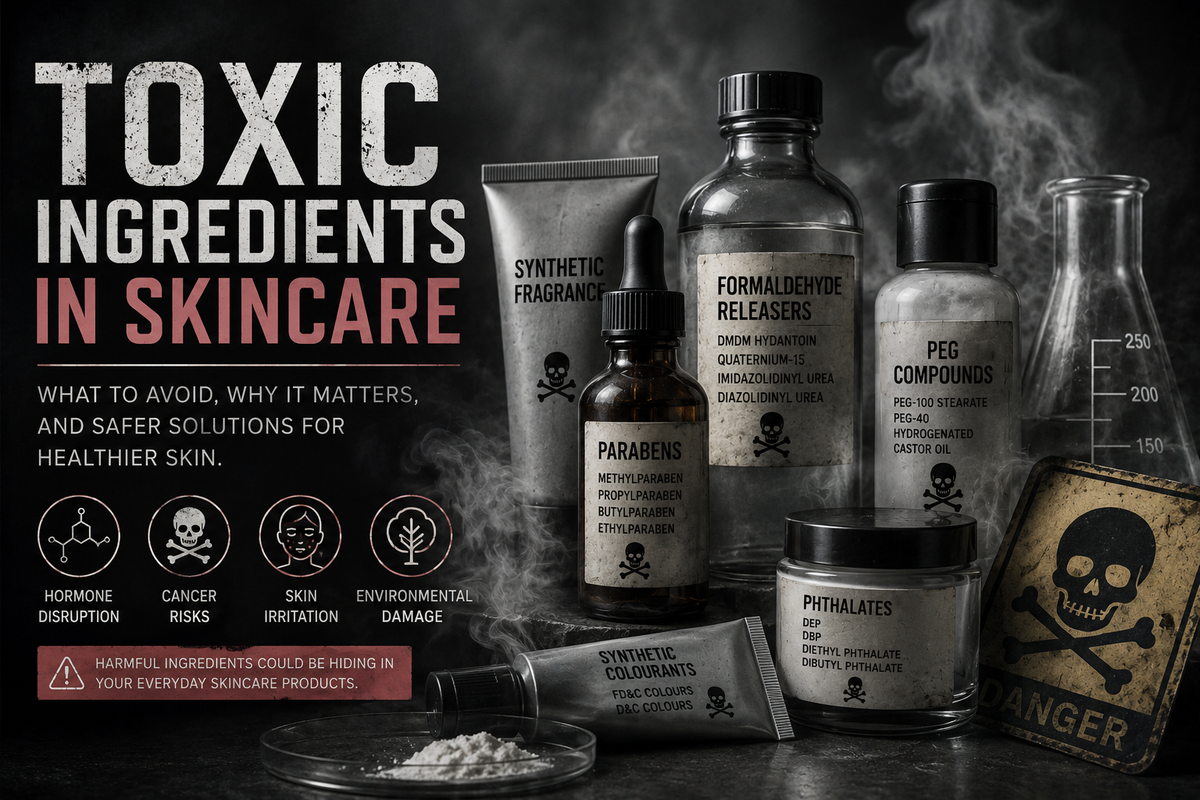
Skincare Ingredients to Avoid: Parabens, Sulphates, and Synthetic Fillers Explained.
Potentially Harmful Ingredients in Skincare: What Should You Really Know?
The modern skincare industry offers an enormous range of creams, oils, serums, cleansers, moisturisers and body treatments.
Many of these products have long ingredient lists filled with unfamiliar names. That can make it difficult to understand what a formula contains, why each ingredient is present and whether it is suitable for your skin.
An unfamiliar or synthetic ingredient is not automatically harmful. In the same way, a natural ingredient is not automatically suitable for everyone.
What matters is the complete formula, the amount of each ingredient, how the product is used and how your individual skin responds.
Understanding skincare labels can help you make more informed choices without relying on fear or exaggerated claims.
How Cosmetic Safety Is Assessed
Cosmetic ingredients are not assessed in isolation from concentration and exposure.
A substance may be irritating at one concentration but suitable at another. The way a product is formulated also matters because ingredients can interact and influence the performance of the complete formula.
In Great Britain, cosmetic products must undergo a professional safety assessment before being made available to consumers. Certain substances are prohibited, while others are permitted only within defined limits. Products must also have a designated Responsible Person who ensures that the relevant safety and legal requirements are followed.
You can read more through the UK Government guidance on cosmetic product safety.
This does not mean that every product will suit every person. Even an approved cosmetic can cause irritation or an allergic response in someone who is sensitive to a particular ingredient.
Regulatory approval and personal suitability are related, but they are not the same thing.
Why Skincare Formulas Contain Supporting Ingredients
Not every ingredient in a cosmetic formula is included to create an immediate visible effect on the skin.
Some ingredients protect the formula, maintain its consistency or make it pleasant and practical to use.
Preservatives help protect products from bacteria, yeast and mould.
Emulsifiers allow oils and water to remain evenly combined.
Stabilisers help maintain texture and performance.
Solvents help dissolve other ingredients.
Fragrance ingredients create aroma.
Colourants influence appearance.
These ingredients are not automatically unnecessary. In many formulations, they are essential for product safety, stability and usability.
The better question is not whether an ingredient sounds natural or scientific. It is whether the ingredient has a clear purpose and is appropriate for the product and its intended use.
Parabens
Parabens are preservatives used to help prevent the growth of bacteria and mould.
Common examples include methylparaben, ethylparaben, propylparaben and butylparaben.
Parabens became controversial because some laboratory research found that certain parabens could demonstrate weak estrogen like activity. This led to public concern about their potential effect on the endocrine system.
However, a laboratory finding does not automatically show that a cosmetic product causes harm during normal use. Concentration, exposure and the specific paraben involved all matter.
Some parabens are permitted within regulated limits, while others are restricted or prohibited in certain markets. The United States Food and Drug Administration continues to review the available evidence and has not concluded that the parabens currently used in cosmetics make those products unsafe.
More information is available from the FDA guidance on parabens in cosmetics.
People may still choose to avoid parabens because of personal preference or previous sensitivity. That is a valid choice, but it should not be presented as proof that every product containing an approved paraben is dangerous.
Formaldehyde Releasing Preservatives
Some cosmetic preservatives release very small quantities of formaldehyde over time. This helps protect a formula against microbial contamination.
Examples can include DMDM hydantoin, diazolidinyl urea, imidazolidinyl urea and quaternium 15.
The main cosmetic concern surrounding these preservatives is skin sensitivity. People with an existing formaldehyde allergy may experience contact dermatitis even at relatively low levels of exposure.
The classification of formaldehyde as a carcinogen relates to particular exposure routes, amounts and circumstances. It should not be used to claim that any cosmetic containing a formaldehyde releasing preservative causes cancer.
Anyone with a diagnosed allergy or a history of contact dermatitis may prefer to avoid these preservatives and should seek advice from a qualified medical professional when necessary.
Fragrance
Fragrance is one of the most common causes of cosmetic sensitivity.
A fragrance blend may contain several aromatic materials. Depending on the product and the applicable labelling rules, not every component will necessarily appear separately on the ingredient list.
Both synthetic fragrance materials and naturally derived aromatic ingredients can cause irritation or an allergic response in sensitive individuals.
Possible reactions may include itching, redness, swelling or a rash. The FDA identifies fragrances and preservatives among the common allergens found in cosmetics.
This does not mean that fragranced skincare is unsuitable for everyone. Many people use it without difficulty and consider aroma an important part of the experience.
People with reactive skin, eczema, fragrance allergies or a history of unexplained irritation may prefer a fragrance free facial product or a formula with a short and clearly disclosed ingredient list.
Phthalates
Phthalates are a family of chemicals with different functions and safety profiles.
Certain phthalates have previously been used in fragrance systems, nail products and other cosmetics. Some members of this ingredient family have been prohibited or restricted, while others remain permitted.
It is therefore misleading to describe every phthalate as if it were the same substance.
According to the FDA, the available evidence has not established that phthalates used in cosmetics present a safety risk under current conditions of use. Their use in cosmetics has also declined considerably.
You can review the current position through the FDA information on phthalates in cosmetics.
Consumers who prefer to avoid them can check ingredient labels and contact a manufacturer for additional information about its fragrance system.
PEG Compounds
Polyethylene glycol compounds can perform several functions in skincare. They may act as emulsifiers, solvents, cleansing agents or texture supporting ingredients.
Concern about PEG compounds often relates to the possible presence of 1,4 dioxane, which can form as a trace manufacturing byproduct in some ingredients.
This does not mean that PEG compounds are themselves 1,4 dioxane or that every product containing them is unsafe.
Manufacturing quality and purification are important. The FDA reports that recent assessments have considered trace amounts of 1,4 dioxane at or below 10 parts per million in cosmetic products to be within an acceptable margin of safety.
Further details are available in the FDA guidance on 1,4 dioxane in cosmetics.
Consumers are free to choose formulas without PEG compounds, but contamination concerns should not be used to make blanket claims about every ingredient or finished product within this broad category.
Colourants
Colourants are used to influence the appearance of a cosmetic product.
They may not provide a direct skin conditioning benefit, but appearance can still be part of the intended product experience.
Permitted cosmetic colourants are regulated. As with fragrance and preservatives, some people may experience sensitivity to a particular colourant.
If your skin is easily irritated, a product without added colour may be a simpler choice. However, the presence of an approved colourant does not automatically make a cosmetic harmful.
Triclosan
Triclosan is an antimicrobial ingredient that was once found in a wider range of personal care products.
Its use has declined because of regulatory changes, environmental concerns and questions about whether antimicrobial ingredients are necessary in everyday consumer products.
The rules governing triclosan depend on the product type and the country in which it is sold. Its presence should be considered within that regulatory context rather than treated as evidence that a product is automatically dangerous.
Natural Ingredients Can Cause Reactions Too
Ingredient awareness should apply equally to natural and synthetic materials.
Botanical extracts, essential oils and naturally occurring aromatic compounds can all cause sensitivity in some people. Ingredients such as limonene, linalool, citral and geraniol occur naturally in many plant oils but may still need to be declared as fragrance allergens.
This does not make natural skincare unsafe. It simply means that natural ingredients should be selected carefully, formulated responsibly and communicated honestly.
If you have sensitive skin, introduce new products gradually and consider testing a small area before applying them more widely. Stop using a product if persistent irritation develops.
Questions Worth Asking About Skincare
You do not need to fear a long ingredient name. You need enough information to make a sensible decision.
Consider asking:
-
What is the purpose of each ingredient?
-
Is the complete ingredient list clearly available?
-
Is the formula suitable for my skin type?
-
Does it contain fragrance or known allergens?
-
Does the brand explain the intended use clearly?
-
Has the finished product undergone the required safety assessment?
-
Does the product deliver the skin experience I actually want?
Thoughtful skincare is not about finding a formula with the fewest possible ingredients. It is about choosing a well considered formula in which every ingredient has a clear role.
The Rebel Palm Approach
Rebel Palm takes a focused approach to skincare.
Our formulas are created around carefully selected botanical oils, plant derived emollients, antioxidants and aromatic components. Each product is designed to deliver a particular skin experience, from lightweight morning conditioning to a richer evening ritual.
We do not suggest that conventional cosmetic ingredients are inherently harmful. Creams, lotions and botanical oils are different formula formats created for different preferences.
Our choice is to specialise in concentrated natural oils because of the way they spread, absorb and leave the skin feeling soft, smooth and beautifully conditioned.
It is a positive formulation choice, not a fear based one.
Essence Light
Essence Light is a lightweight morning body oil created for soft, smooth and comfortable looking skin.
It spreads easily, absorbs quickly and leaves a clean satin finish without a heavy or greasy feel.
It is especially suited to anyone who wants simple daily body care that fits naturally into a morning routine.
Satis
Satis is designed to be applied after showering, when the skin is clean and ready for care.
Its botanical oils help reduce the dry, tight feeling that can follow bathing while leaving the body feeling silky, conditioned and cared for.
The result is touchably soft skin with an elegant finish.
Velora
Velora is a richer evening body oil created for dry feeling skin and a more indulgent night time ritual.
It leaves the skin feeling deeply conditioned, smooth and comfortable before rest.
The experience is calming, luxurious and intentionally unhurried.
Lumen Elixir
Lumen Elixir is a luxury natural facial oil created for smooth, luminous and beautifully refined looking skin.
Its concentrated botanical formula glides across the face and leaves a radiant satin finish.
It is especially suited to dull looking skin, dry feeling skin and anyone wanting to restore the appearance of softness and glow.
Choosing Skincare With Confidence
Fear is not a useful foundation for skincare.
Synthetic does not automatically mean harmful. Natural does not automatically mean gentle. A longer ingredient list is not necessarily worse, and a shorter one is not necessarily better.
A good formula should be safe, purposeful, clearly presented and suitable for the person using it.
Rebel Palm believes consumers deserve honest information and beautifully considered products. Our approach centres on natural botanical oils, thoughtful formulation and the visible experience of healthy looking skin.
No exaggerated warnings.
No impossible promises.
Just purposeful natural skincare designed to leave the skin feeling soft, smooth, comfortable and cared for.
Final Thoughts
Ingredient awareness is valuable when it leads to better understanding rather than unnecessary fear.
Preservatives, emulsifiers, fragrances, colourants and other supporting ingredients can perform legitimate functions within cosmetic products. Some may also cause irritation or allergic reactions in sensitive individuals.
The goal is not to label entire categories as good or bad.
The goal is to understand the formula, recognise your skin’s individual needs and choose products that align with your preferences.
For Rebel Palm, that means concentrated natural skincare created with botanical oils and a clear purpose.
Skincare should feel considered.
It should feel enjoyable.
Most importantly, it should make you feel good in your own skin.

Written by Andrew Karczewski
Visit author's website